Accuracy analysis framework for Amazon Q Enterprise – Half 2

Within the first post of this collection, we launched a complete analysis framework for Amazon Q Business, a totally managed Retrieval Augmented Era (RAG) resolution that makes use of your organization’s proprietary information with out the complexity of managing massive language fashions (LLMs). The primary submit centered on deciding on applicable use instances, getting ready information, and implementing metrics to assist a human-in-the-loop analysis course of.
On this submit, we dive into the answer structure essential to implement this analysis framework in your Amazon Q Enterprise utility. We discover two distinct analysis options:
- Complete analysis workflow – This ready-to-deploy resolution makes use of AWS CloudFormation stacks to arrange an Amazon Q Enterprise utility, full with person entry, a customized UI for evaluate and analysis, and the supporting analysis infrastructure
- Light-weight AWS Lambda based mostly analysis – Designed for customers with an current Amazon Q Enterprise utility, this streamlined resolution employs an AWS Lambda operate to effectively assess the appliance’s accuracy
By the top of this submit, you’ll have a transparent understanding of learn how to implement an analysis framework that aligns together with your particular wants with an in depth walkthrough, so your Amazon Q Enterprise utility delivers correct and dependable outcomes.
Challenges in evaluating Amazon Q Enterprise
Evaluating the efficiency of Amazon Q Enterprise, which makes use of a RAG mannequin, presents a number of challenges as a result of its integration of retrieval and era elements. It’s essential to determine which features of the answer want analysis. For Amazon Q Enterprise, each the retrieval accuracy and the standard of the reply output are essential elements to evaluate. On this part, we focus on key metrics that have to be included for a RAG generative AI resolution.
Context recall
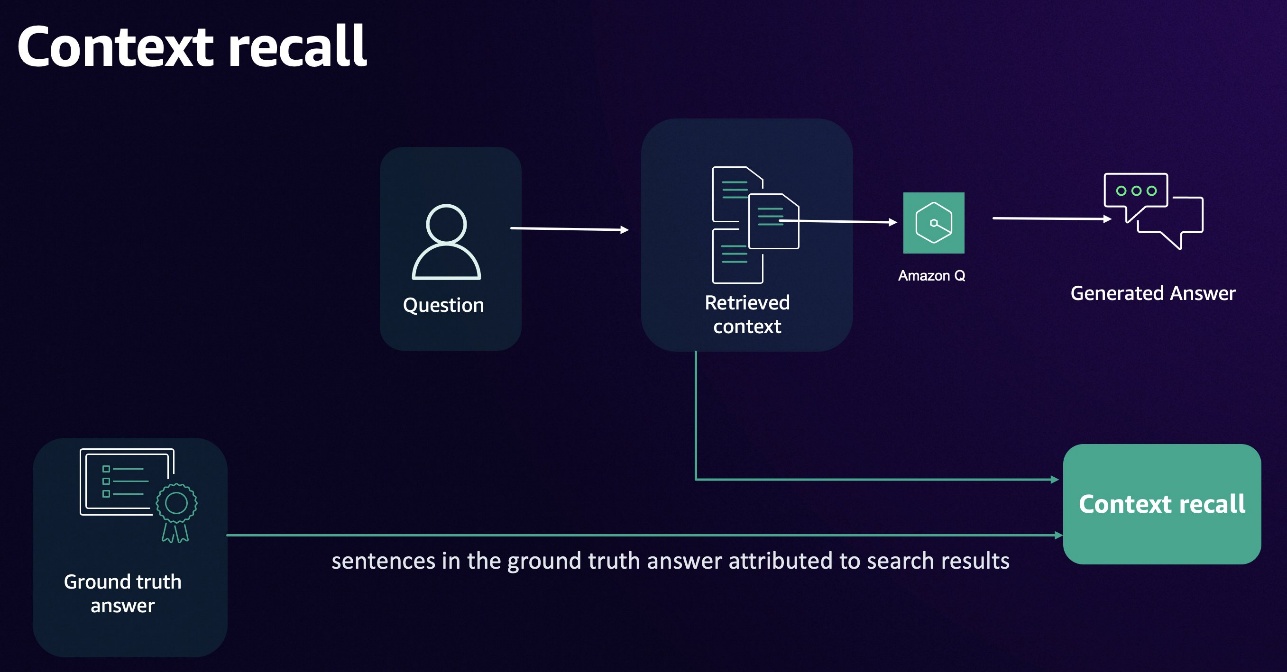
Context recall measures the extent to which all related content material is retrieved. Excessive recall gives complete data gathering however would possibly introduce extraneous information.
For instance, a person would possibly ask the query “What are you able to inform me in regards to the geography of america?” They may get the next responses:
- Anticipated: The US is the third-largest nation on this planet by land space, protecting roughly 9.8 million sq. kilometers. It has a various vary of geographical options.
- Excessive context recall: The US spans roughly 9.8 million sq. kilometers, making it the third-largest nation globally by land space. nation’s geography is extremely various, that includes the Rocky Mountains stretching from New Mexico to Alaska, the Appalachian Mountains alongside the jap states, the expansive Nice Plains within the central area, arid deserts just like the Mojave within the southwest.
- Low context recall: The US options vital geographical landmarks. Moreover, the nation is residence to distinctive ecosystems just like the Everglades in Florida, an enormous community of wetlands.
The next diagram illustrates the context recall workflow.
Context precision
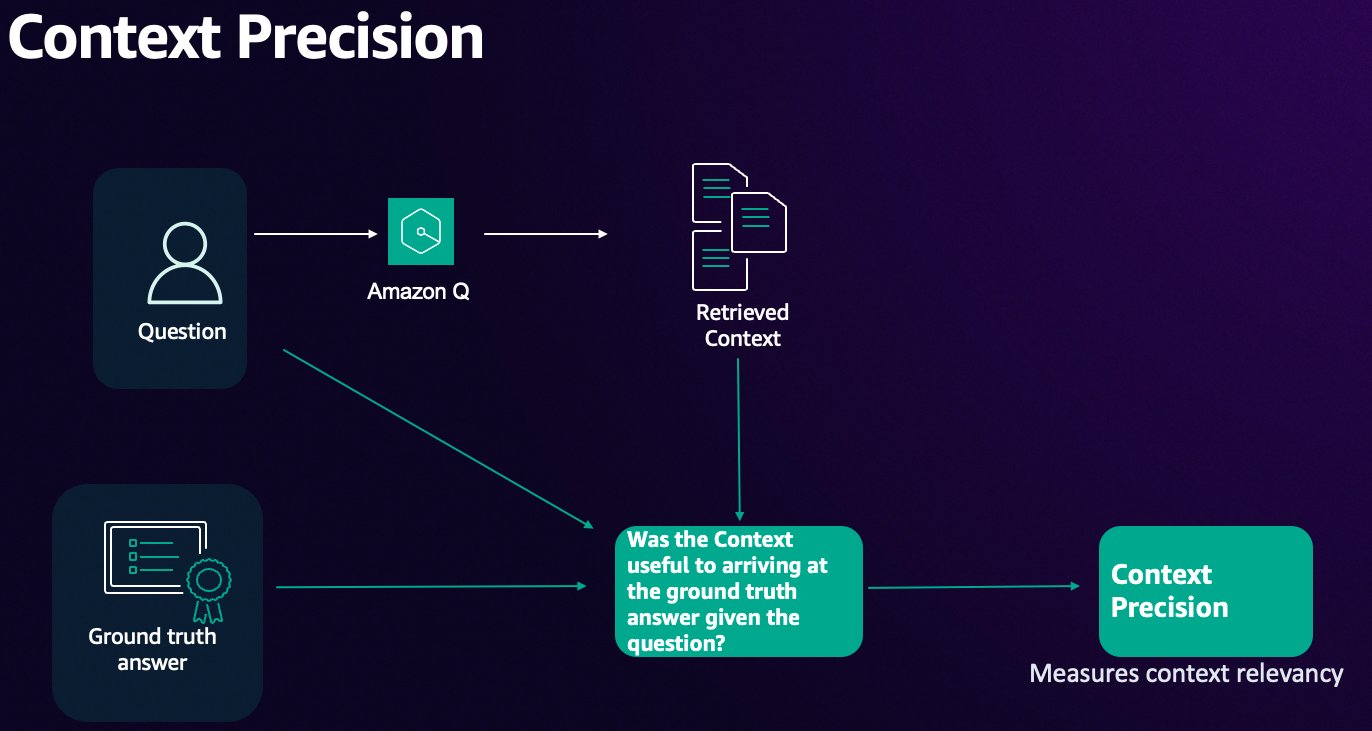
Context precision assesses the relevance and conciseness of retrieved data. Excessive precision signifies that the retrieved data intently matches the question intent, lowering irrelevant information.
For instance, “Why Silicon Valley is nice for tech startups?”would possibly give the next solutions:
- Floor reality reply: Silicon Valley is legendary for fostering innovation and entrepreneurship within the know-how sector.
- Excessive precision context: Many groundbreaking startups originate from Silicon Valley, benefiting from a tradition that encourages innovation, risk-taking
- Low precision context: Silicon Valley experiences a Mediterranean local weather, with gentle, moist, winters and heat, dry summers, contributing to its attraction as a spot to dwell and works
The next diagram illustrates the context precision workflow.
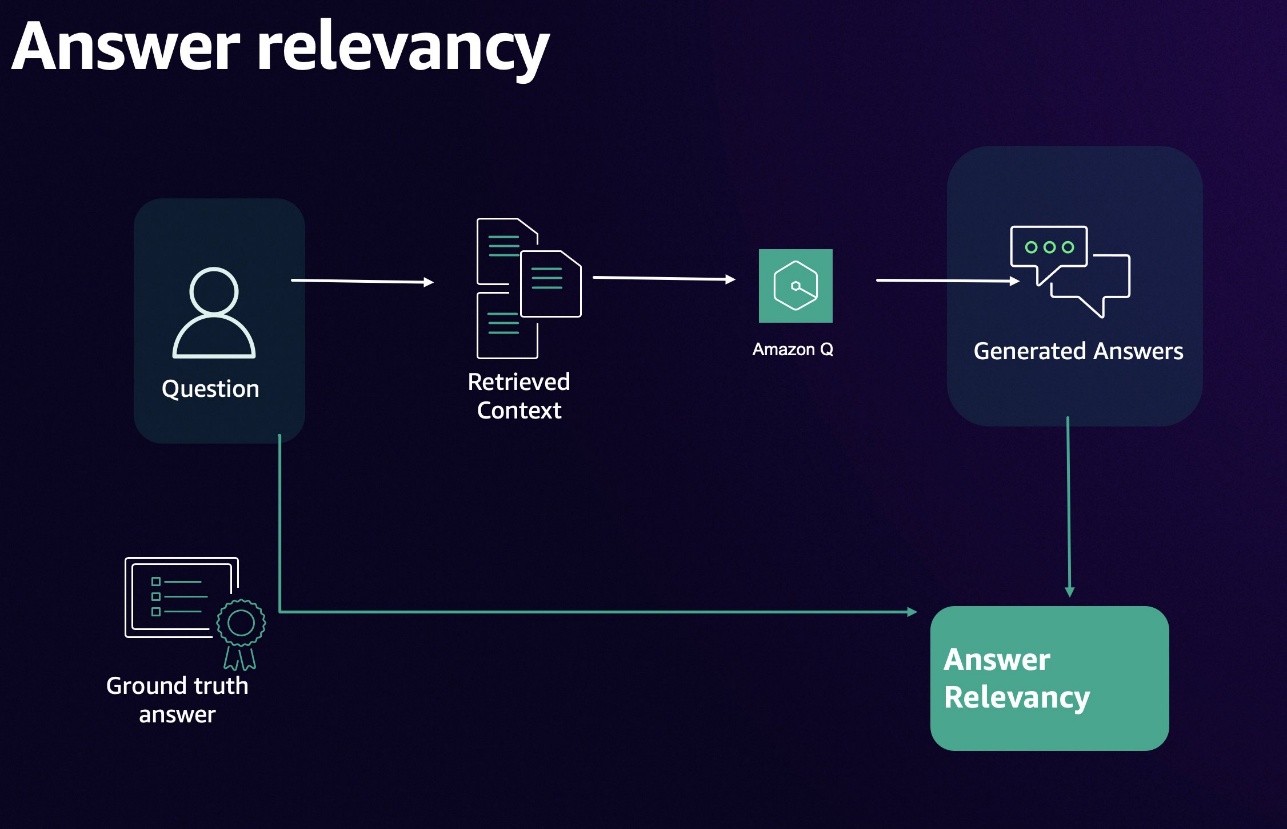
Reply relevancy
Reply relevancy evaluates whether or not responses absolutely deal with the question with out pointless particulars. Related solutions improve person satisfaction and belief within the system.
For instance, a person would possibly ask the query “What are the important thing options of Amazon Q Enterprise Service, and the way can it profit enterprise clients?” They may get the next solutions:
- Excessive relevance reply: Amazon Q Enterprise Service is a RAG Generative AI resolution designed for enterprise use. Key options embrace a totally managed Generative AI options, integration with enterprise information sources, sturdy safety protocols, and customizable digital assistants. It advantages enterprise clients by enabling environment friendly data retrieval, automating buyer assist duties, enhancing worker productiveness via fast entry to information, and offering insights via analytics on person interactions.
- Low relevance reply: Amazon Q Enterprise Service is a part of Amazon’s suite of cloud companies. Amazon additionally provides on-line buying and streaming companies.
The next diagram illustrates the reply relevancy workflow.
Truthfulness
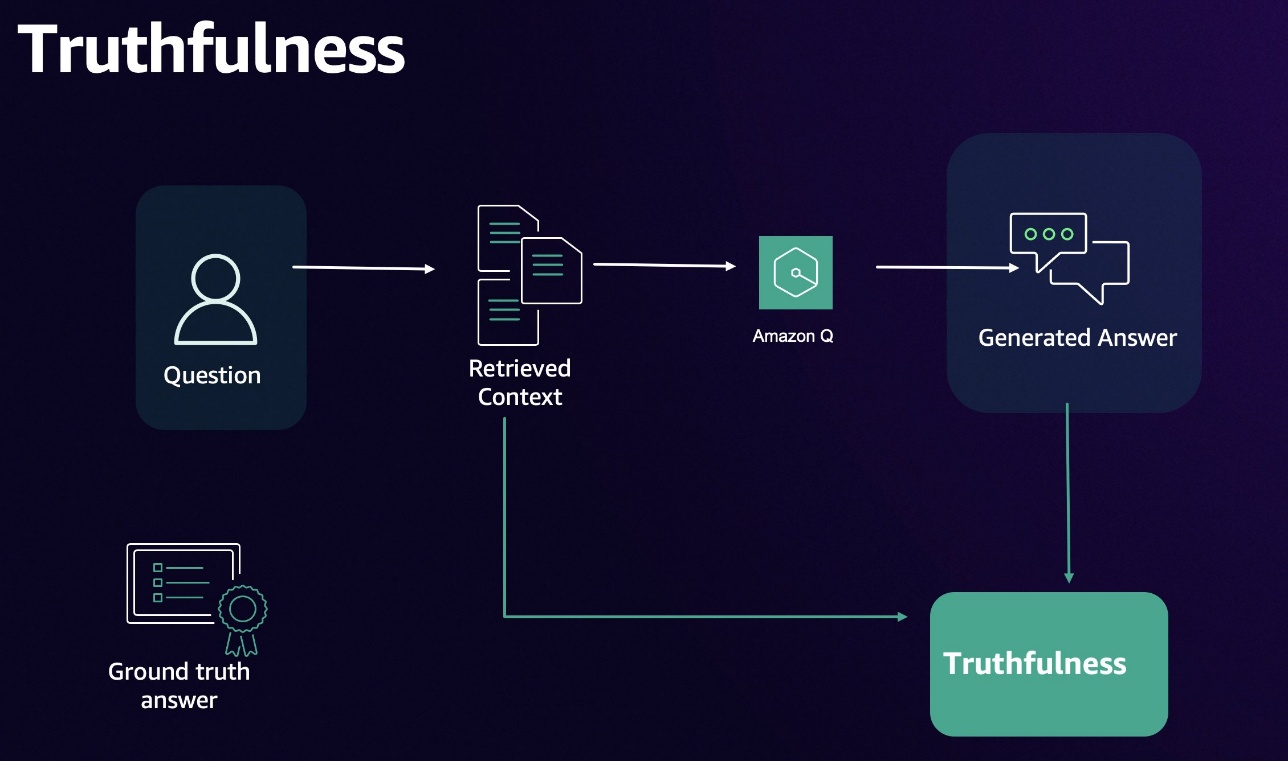
Truthfulness verifies factual accuracy by evaluating responses to verified sources. Truthfulness is essential to keep up the system’s credibility and reliability.
For instance, a person would possibly ask “What’s the capital of Canada?” They may get the next responses:
- Context: Canada’s capital metropolis is Ottawa, situated within the province of Ontario. Ottawa is thought for its historic Parliament Hill, the middle of presidency, and the scenic Rideau Canal, a UNESCO World Heritage website
- Excessive truthfulness reply: The capital of Canada is Ottawa
- Low truthfulness reply: The capital of Canada is Toronto
The next diagram illustrates the truthfulness workflow.
Analysis strategies
Deciding on who ought to conduct the analysis can considerably affect outcomes. Choices embrace:
- Human-in-the-Loop (HITL) – Human evaluators manually assess the accuracy and relevance of responses, providing nuanced insights that automated techniques would possibly miss. Nevertheless, it’s a gradual course of and troublesome to scale.
- LLM-aided analysis – Automated strategies, such because the Ragas framework, use language fashions to streamline the analysis course of. Nevertheless, these won’t absolutely seize the complexities of domain-specific information.
Every of those preparatory and evaluative steps contributes to a structured strategy to evaluating the accuracy and effectiveness of Amazon Q Enterprise in supporting enterprise wants.
Answer overview
On this submit, we discover two totally different options to supply you the main points of an analysis framework, so you should use it and adapt it in your personal use case.
Answer 1: Finish-to-end analysis resolution
For a fast begin analysis framework, this resolution makes use of a hybrid strategy with Ragas (automated scoring) and HITL analysis for sturdy accuracy and reliability. The structure contains the next elements:
- Consumer entry and UI – Authenticated customers work together with a frontend UI to add datasets, evaluate RAGAS output, and supply human suggestions
- Analysis resolution infrastructure – Core elements embrace:
- Ragas scoring – Automated metrics present an preliminary layer of analysis
- HITL evaluate – Human evaluators refine Ragas scores via the UI, offering nuanced accuracy and reliability
By integrating a metric-based strategy with human validation, this structure makes positive Amazon Q Enterprise delivers correct, related, and reliable responses for enterprise customers. This resolution additional enhances the analysis course of by incorporating HITL evaluations, enabling human suggestions to refine automated scores for increased precision.
A fast video demo of this resolution is proven under:
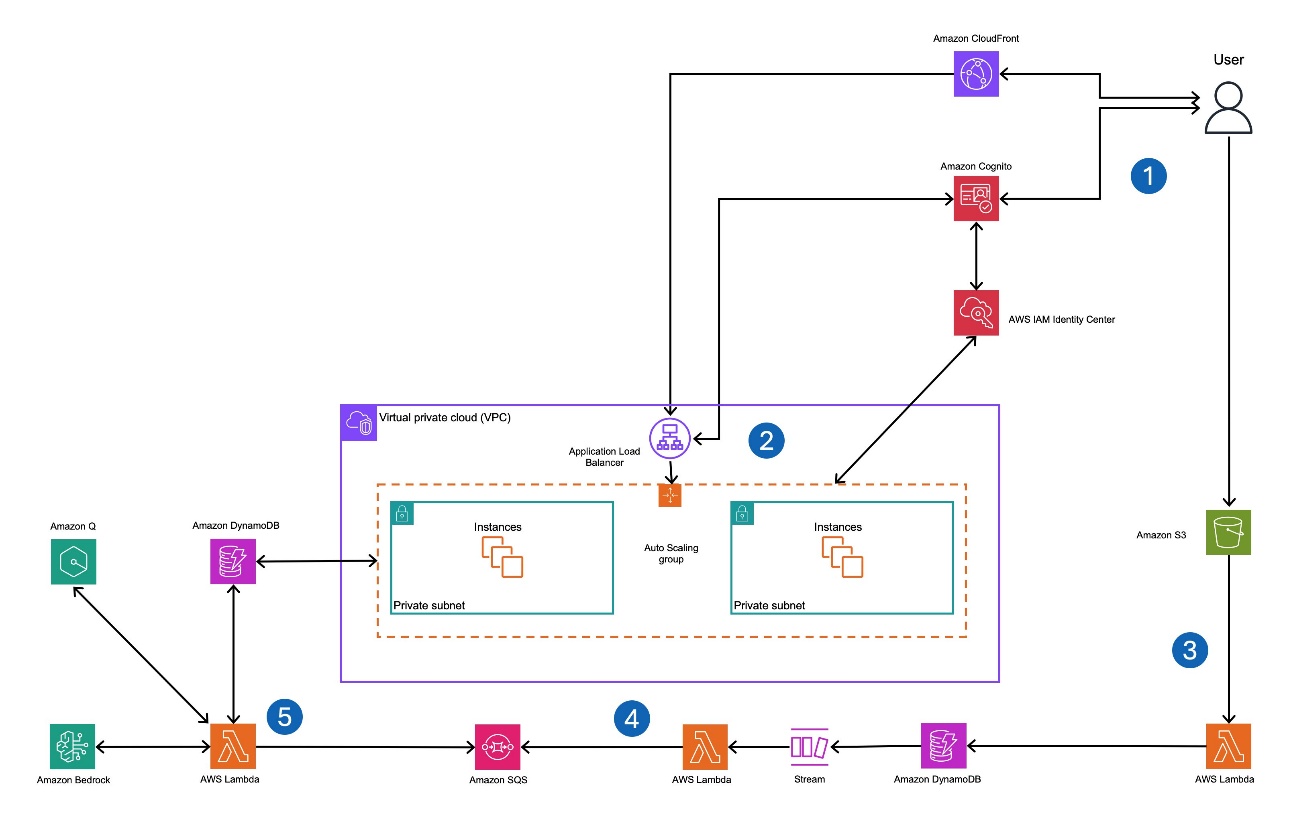
Answer structure
The answer structure is designed with the next core functionalities to assist an analysis framework for Amazon Q Enterprise:
- Consumer entry and UI – Customers authenticate via Amazon Cognito, and upon profitable login, work together with a Streamlit-based customized UI. This frontend permits customers to add CSV datasets to Amazon Simple Storage Service (Amazon S3), evaluate Ragas analysis outputs, and supply human suggestions for refinement. The appliance exchanges the Amazon Cognito token for an AWS IAM Identity Center token, granting scoped entry to Amazon Q Enterprise.UI
- infrastructure – The UI is hosted behind an Application Load Balancer, supported by Amazon Elastic Compute Cloud (Amazon EC2) situations working in an Auto Scaling group for prime availability and scalability.
- Add dataset and set off analysis – Customers add a CSV file containing queries and floor reality solutions to Amazon S3, which triggers an analysis course of. A Lambda operate reads the CSV, shops its content material in a DynamoDB desk, and initiates additional processing via a DynamoDB stream.
- Consuming DynamoDB stream – A separate Lambda operate processes new entries from the DynamoDB stream, and publishes messages to an SQS queue, which serves as a set off for the analysis Lambda operate.
- Ragas scoring – The analysis Lambda operate consumes SQS messages, sending queries (prompts) to Amazon Q Enterprise for producing solutions. It then evaluates the immediate, floor reality, and generated reply utilizing the Ragas analysis framework. Ragas computes automated analysis metrics similar to context recall, context precision, reply relevancy, and truthfulness. The outcomes are saved in DynamoDB and visualized within the UI.
HITL evaluate – Authenticated customers can evaluate and refine RAGAS scores instantly via the UI, offering nuanced and correct evaluations by incorporating human insights into the method.
This structure makes use of AWS companies to ship a scalable, safe, and environment friendly analysis resolution for Amazon Q Enterprise, combining automated and human-driven evaluations.
Conditions
For this walkthrough, you must have the next conditions:
Moreover, guarantee that all of the sources you deploy are in the identical AWS Area.
Deploy the CloudFormation stack
Full the next steps to deploy the CloudFormation stack:
- Clone the repository or obtain the files to your native pc.
- Unzip the downloaded file (should you used this selection).
- Utilizing your native pc command line, use the ‘cd’ command and alter listing into
./sample-code-for-evaluating-amazon-q-business-applications-using-ragas-main/end-to-end-solution - Ensure the
./deploy.shscript can run by executing the commandchmod 755 ./deploy.sh. - Execute the CloudFormation deployment script offered as follows:
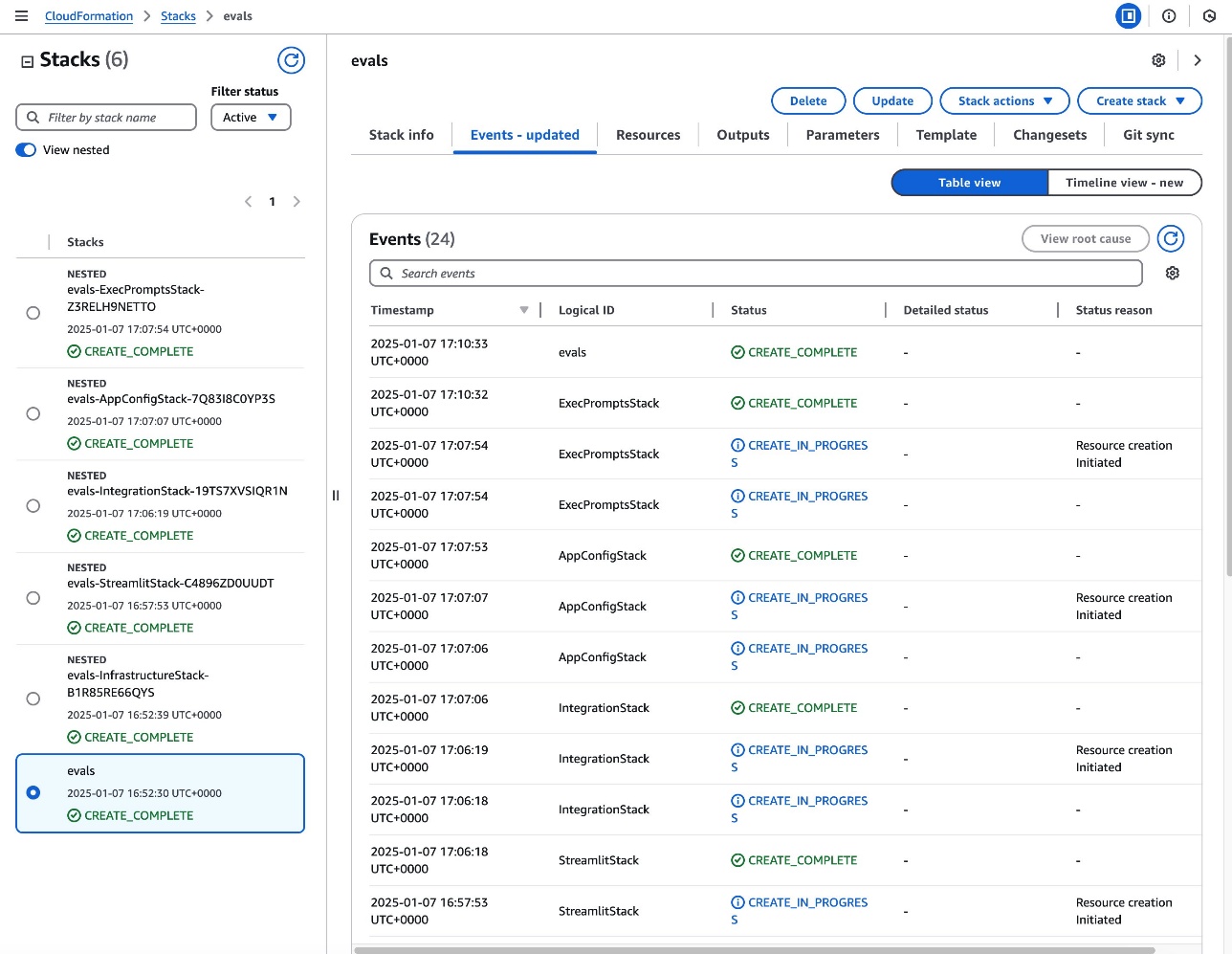
You possibly can observe the deployment progress on the AWS CloudFormation console. It takes roughly quarter-hour to finish the deployment, after which you will notice the same web page to the next screenshot.
Add customers to Amazon Q Enterprise
You could provision customers for the pre-created Amazon Q Enterprise utility. Check with Setting up for Amazon Q Business for directions so as to add customers.
Add the analysis dataset via the UI
On this part, you evaluate and add the next CSV file containing an analysis dataset via the deployed customized UI.
This CSV file comprises two columns: immediate and ground_truth. There are 4 prompts and their related floor reality on this dataset:
- What are the index forms of Amazon Q Enterprise and the options of every?
- I wish to use Q Apps, which subscription tier is required to make use of Q Apps?
- What’s the file measurement restrict for Amazon Q Enterprise through file add?
- What information encryption does Amazon Q Enterprise assist?
To add the analysis dataset, full the next steps:
- On the AWS CloudFormation console, select Stacks within the navigation pane.
- Select the
evalsstack that you simply already launched. - On the Outputs tab, be aware of the person identify and password to log in to the UI utility, and select the UI URL.
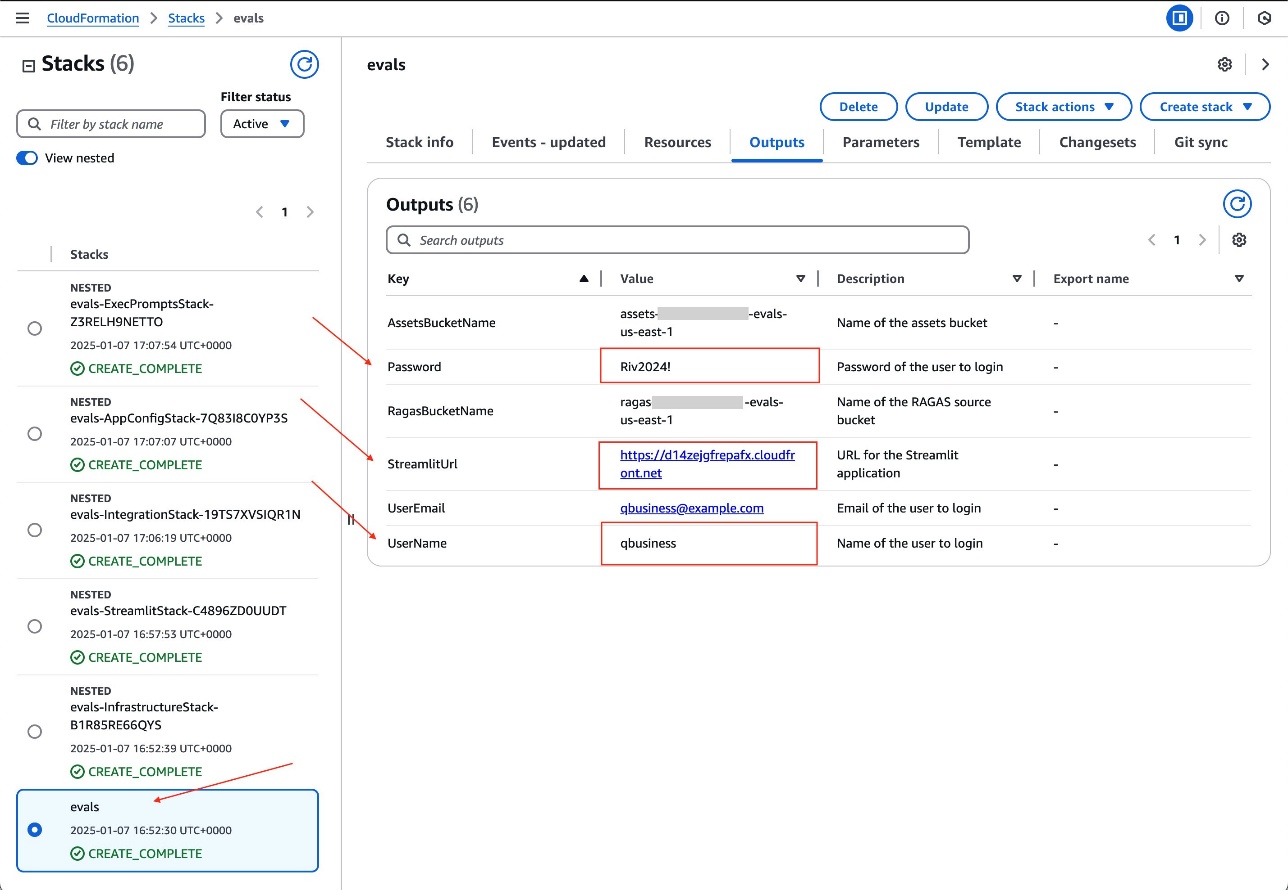
The customized UI will redirect you to the Amazon Cognito login web page for authentication.
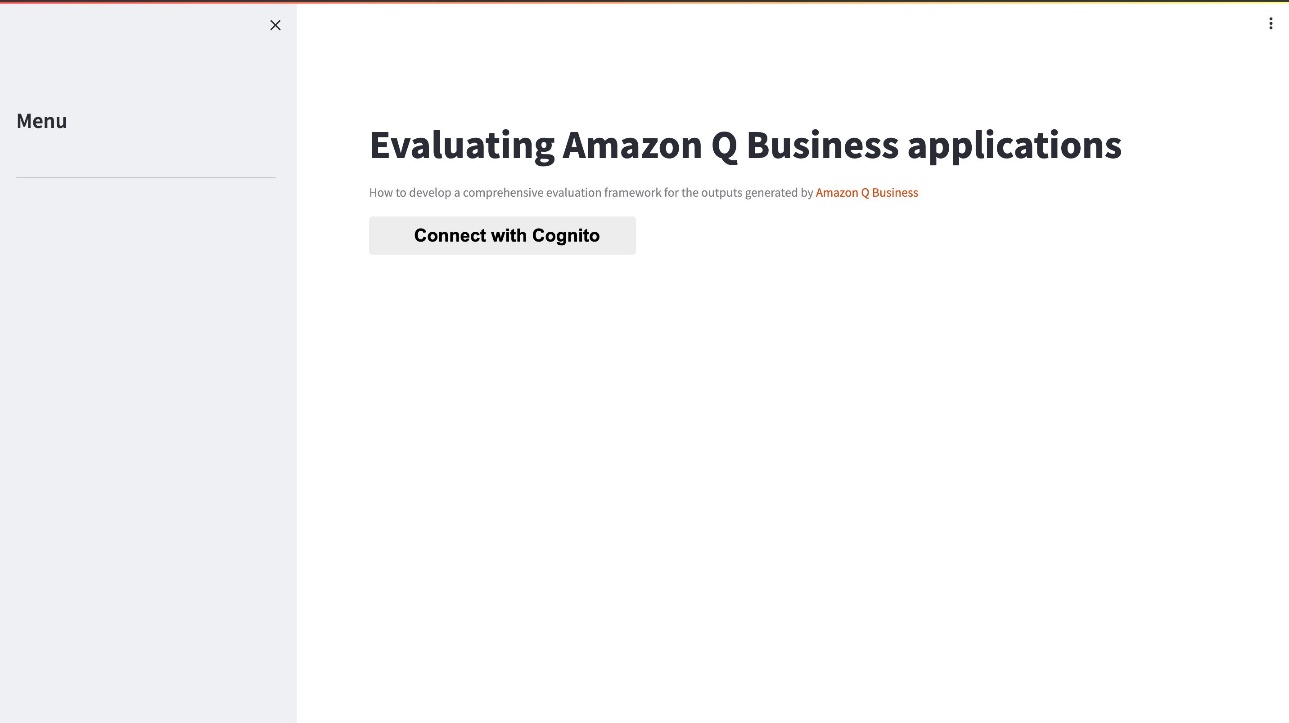
The UI utility authenticates the person with Amazon Cognito, and initiates the token change workflow to implement a safe Chatsync API name with Amazon Q Enterprise.
- Use the credentials you famous earlier to log in.
For extra details about the token change stream between IAM Identification Heart and the identification supplier (IdP), seek advice from Building a Custom UI for Amazon Q Business.
- After you log in to the customized UI used for Amazon Q analysis, select Add Dataset, then add the dataset CSV file.
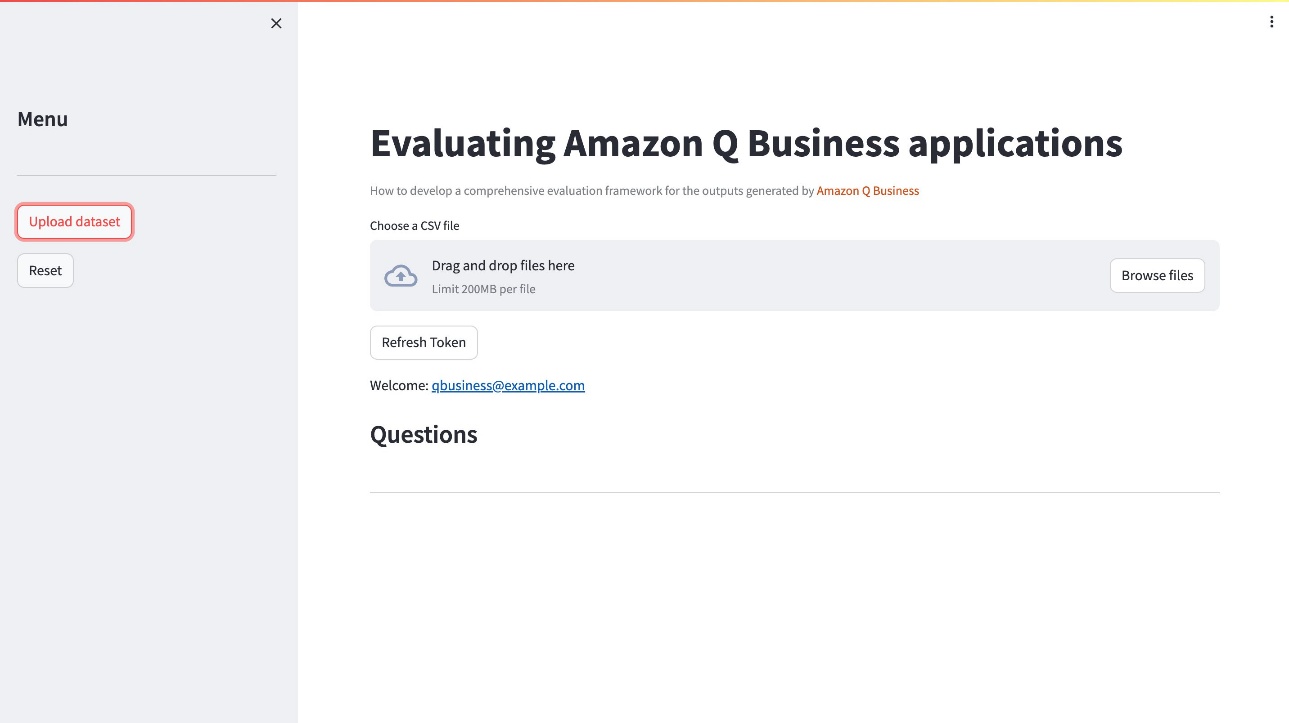
After the file is uploaded, the analysis framework will ship the immediate to Amazon Q Enterprise to generate the reply, after which ship the immediate, floor reality, and reply to Ragas to guage. Throughout this course of, you may as well evaluate the uploaded dataset (together with the 4 questions and related floor reality) on the Amazon Q Enterprise console, as proven within the following screenshot.

After about 7 minutes, the workflow will end, and you must see the analysis end result for first query.

Carry out HITL analysis
After the Lambda operate has accomplished its execution, Ragas scoring will probably be proven within the customized UI. Now you possibly can evaluate metric scores generated utilizing Ragas (an-LLM aided analysis technique), and you’ll present human suggestions as an evaluator to supply additional calibration. This human-in-the-loop calibration can additional enhance the analysis accuracy, as a result of the HITL course of is especially useful in fields the place human judgment, experience, or moral issues are essential.
Let’s evaluate the primary query: “What are the index forms of Amazon Q Enterprise and the options of every?” You possibly can learn the query, Amazon Q Enterprise generated solutions, floor reality, and context.
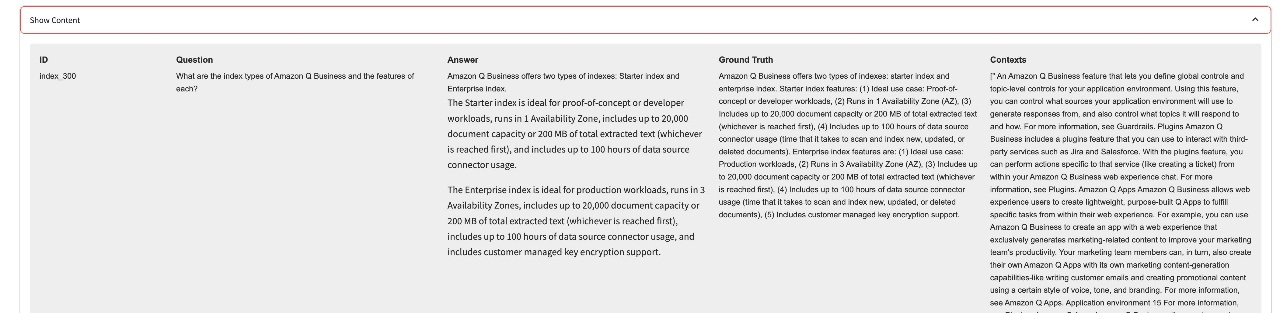
Subsequent, evaluate the analysis metrics scored through the use of Ragas. As mentioned earlier, there are 4 metrics:
- Reply relevancy – Measures relevancy of solutions. Larger scores point out higher alignment with the person enter, and decrease scores are given if the response is incomplete or contains redundant data.
- Truthfulness – Verifies factual accuracy by evaluating responses to verified sources. Larger scores point out a greater consistency with verified sources.
- Context precision – Assesses the relevance and conciseness of retrieved data. Larger scores point out that the retrieved data intently matches the question intent, lowering irrelevant information.
- Context recall – Measures how most of the related paperwork (or items of knowledge) have been efficiently retrieved. It focuses on not lacking essential outcomes. Larger recall means fewer related paperwork have been unnoticed.
For this query, all metrics confirmed Amazon Q Enterprise achieved a high-quality response. It’s worthwhile to check your personal analysis with these scores generated by Ragas.

Subsequent, let’s evaluate a query that returned with a low reply relevancy rating. For instance: “I wish to use Q Apps, which subscription tier is required to make use of Q Apps?”
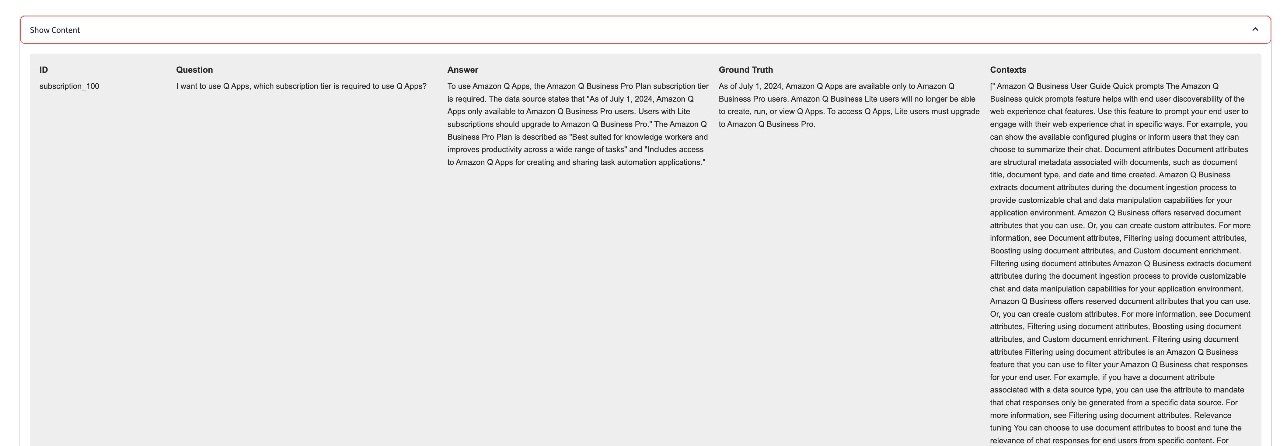
Analyzing each query and reply, we will take into account the reply related and aligned with the person query, however the reply relevancy rating from Ragas doesn’t mirror this human evaluation, displaying a decrease rating than anticipated. It’s essential to calibrate Ragas analysis judgement as Human within the Lopp. You must learn the query and reply fastidiously, and make vital modifications of the metric rating to mirror the HITL evaluation. Lastly, the outcomes will probably be up to date in DynamoDB.

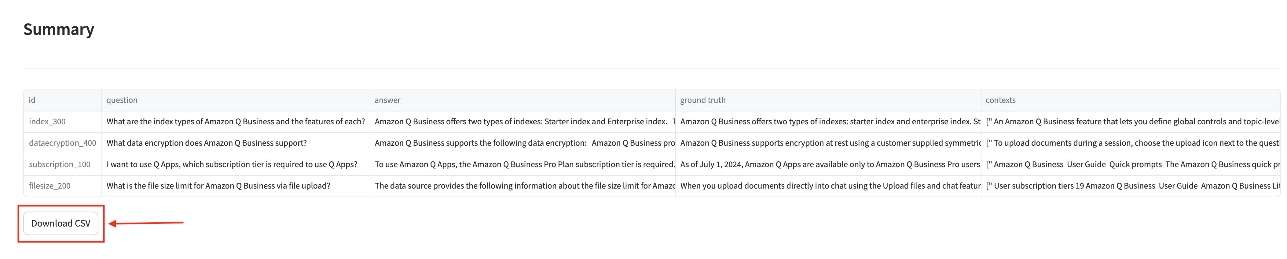
Lastly, save the metric rating within the CSV file, and you’ll obtain and evaluate the ultimate metric scores.
Answer 2: Lambda based mostly analysis
If you happen to’re already utilizing Amazon Q Enterprise, AmazonQEvaluationLambda permits for fast integration of analysis strategies into your utility with out establishing a customized UI utility. It provides the next key options:
- Evaluates responses from Amazon Q Enterprise utilizing Ragas towards a predefined check set of questions and floor reality information
- Outputs analysis metrics that may be visualized instantly in Amazon CloudWatch
- Each options present you outcomes based mostly on the enter dataset and the responses from the Amazon Q Enterprise utility, utilizing Ragas to guage 4 key analysis metrics (context recall, context precision, reply relevancy, and truthfulness).
This resolution gives you pattern code to guage the Amazon Q Enterprise utility response. To make use of this resolution, you have to have or create a working Amazon Q Enterprise utility built-in with IAM Identification Heart or Amazon Cognito as an IdP. This Lambda operate works in the identical method because the Lambda operate within the end-to-end analysis resolution, utilizing RAGAS towards a check set of questions and floor reality. This light-weight resolution doesn’t have a customized UI, however it might probably present end result metrics (context recall, context precision, reply relevancy, truthfulness), for visualization in CloudWatch. For deployment directions, seek advice from the next GitHub repo.
Utilizing analysis outcomes to enhance Amazon Q Enterprise utility accuracy
This part outlines methods to boost key analysis metrics—context recall, context precision, reply relevance, and truthfulness—for a RAG resolution within the context of Amazon Q Enterprise.
Context recall
Let’s look at the next issues and troubleshooting suggestions:
- Aggressive question filtering – Overly strict search filters or metadata constraints would possibly exclude related data. You must evaluate the metadata filters or boosting settings applied in Amazon Q Business to verify they don’t unnecessarily prohibit outcomes.
- Knowledge supply ingestion errors – Paperwork from sure information sources aren’t efficiently ingested into Amazon Q Enterprise. To handle this, test the document sync history report in Amazon Q Enterprise to verify profitable ingestion and resolve ingestion errors.
Context precision
Contemplate the next potential points:
- Over-retrieval of paperwork – Massive top-Ok values would possibly retrieve semi-related or off-topic passages, which the LLM would possibly incorporate unnecessarily. To handle this, refine metadata filters or apply boosting to enhance passage relevance and cut back noise within the retrieved context.
- Poor question specificity – Broad or poorly fashioned person queries can yield loosely associated outcomes. You must be certain that person queries are clear and particular. Practice customers or implement question refinement mechanisms to optimize question high quality.
Reply relevance
Contemplate the next troubleshooting strategies:
- Partial protection – Retrieved context addresses components of the query however fails to cowl all features, particularly in multi-part queries. To handle this, decompose advanced queries into sub-questions. Instruct the LLM or a devoted module to retrieve and reply every sub-question earlier than composing the ultimate response. For instance:
- Break down the question into sub-questions.
- Retrieve related passages for every sub-question.
- Compose a remaining reply addressing every half.
- Context/reply mismatch – The LLM would possibly misread retrieved passages, omit related data, or merge content material incorrectly as a result of hallucination. You need to use immediate engineering to information the LLM extra successfully. For instance, for the unique question “What are the highest 3 causes for X?” you should use the rewritten immediate “Listing the highest 3 causes for X clearly labeled as #1, #2, and #3, based mostly strictly on the retrieved context.”
Truthfulness
Contemplate the next:
- Stale or inaccurate information sources – Outdated or conflicting data within the information corpus would possibly result in incorrect solutions. To handle this, examine the retrieved context with verified sources to supply accuracy. Collaborate with SMEs to validate the information.
- LLM hallucination – The mannequin would possibly fabricate or embellish particulars, even with correct retrieved context. Though Amazon Q Enterprise is a RAG generative AI resolution, and may considerably cut back the hallucination, it’s not attainable to eradicate hallucination completely. You possibly can measure the frequency of low context precision solutions to determine patterns and quantify the affect of hallucinations to achieve an aggregated view with the analysis resolution.
By systematically analyzing and addressing the basis causes of low analysis metrics, you possibly can optimize your Amazon Q Enterprise utility. From doc retrieval and rating to immediate engineering and validation, these methods will assist improve the effectiveness of your RAG resolution.
Clear up
Don’t overlook to return to the CloudFormation console and delete the CloudFormation stack to delete the underlying infrastructure that you simply arrange, to keep away from further prices in your AWS account.
Conclusion
On this submit, we outlined two analysis options for Amazon Q Enterprise: a complete analysis workflow and a light-weight Lambda based mostly analysis. These approaches mix automated analysis approaches similar to Ragas with human-in-the-loop validation, offering dependable and correct assessments.
Through the use of our steering on learn how to enhance analysis metrics, you possibly can constantly optimize your Amazon Q Enterprise utility to fulfill enterprise wants with Amazon Q Enterprise. Whether or not you’re utilizing the end-to-end resolution or the light-weight strategy, these frameworks present a scalable and environment friendly path to enhance accuracy and relevance.
To be taught extra about Amazon Q Enterprise and learn how to consider Amazon Q Enterprise outcomes, discover these hands-on workshops:
In regards to the authors
 Rui Cardoso is a companion options architect at Amazon Internet Providers (AWS). He’s specializing in AI/ML and IoT. He works with AWS Companions and assist them in growing options in AWS. When not working, he enjoys biking, mountain climbing and studying new issues.
 Julia Hu is a Sr. AI/ML Options Architect at Amazon Internet Providers. She is specialised in Generative AI, Utilized Knowledge Science and IoT structure. Presently she is a part of the Amazon Bedrock workforce, and a Gold member/mentor in Machine Studying Technical Area Neighborhood. She works with clients, starting from start-ups to enterprises, to develop AWSome generative AI options. She is especially obsessed with leveraging Massive Language Fashions for superior information analytics and exploring sensible functions that deal with real-world challenges.
 Amit Gupta is a Senior Q Enterprise Options Architect Options Architect at AWS. He’s obsessed with enabling clients with well-architected generative AI options at scale.
 Neil Desai is a know-how government with over 20 years of expertise in synthetic intelligence (AI), information science, software program engineering, and enterprise structure. At AWS, he leads a workforce of Worldwide AI companies specialist options architects who assist clients construct revolutionary Generative AI-powered options, share greatest practices with clients, and drive product roadmap. He’s obsessed with utilizing know-how to unravel real-world issues and is a strategic thinker with a confirmed monitor report of success.
 Ricardo Aldao is a Senior Accomplice Options Architect at AWS. He’s a passionate AI/ML fanatic who focuses on supporting companions in constructing generative AI options on AWS.