Amazon SageMaker HyperPod enhances ML infrastructure with scalability and customizability
Amazon SageMaker HyperPod is a purpose-built infrastructure for optimizing basis mannequin (FM) coaching and inference at scale. SageMaker HyperPod removes the undifferentiated heavy lifting concerned in constructing and optimizing machine studying (ML) infrastructure for coaching FMs, decreasing coaching time by as much as 40%.
SageMaker HyperPod affords persistent clusters with built-in resiliency, whereas additionally providing deep infrastructure management by permitting customers to SSH into the underlying Amazon Elastic Compute Cloud (Amazon EC2) cases. It helps effectively scale mannequin growth and deployment duties equivalent to coaching, fine-tuning, or inference throughout a cluster of a whole lot or 1000’s of AI accelerators, whereas decreasing the operational heavy lifting concerned in managing such clusters. As AI strikes in the direction of deployment adopting to a mess of domains and use instances, the necessity for flexibility and management is turning into extra pertinent. Massive enterprises need to ensure that the GPU clusters comply with the organization-wide insurance policies and safety guidelines. Mission-critical AI/ML workloads usually require specialised environments that align with the group’s software program stack and operational requirements.
SageMaker HyperPod helps Amazon Elastic Kubernetes Service (Amazon EKS) and affords two new options that improve this management and suppleness to allow manufacturing deployment of large-scale ML workloads:
- Steady provisioning – SageMaker HyperPod now helps steady provisioning, which reinforces cluster scalability via options like partial provisioning, rolling updates, concurrent scaling operations, and steady retries when launching and configuring your HyperPod cluster.
- Customized AMIs – Now you can use customized Amazon Machine Images (AMIs), which permits the preconfiguration of software program stacks, safety brokers, and proprietary dependencies that might in any other case require complicated post-launch bootstrapping. Clients can create customized AMIs utilizing the HyperPod public AMI as a base and set up further software program required to fulfill their group’s particular safety and compliance necessities.
On this put up, we dive deeper into every of those options.
Steady provisioning
The brand new steady provisioning function in SageMaker HyperPod represents a transformative development for organizations operating intensive ML workloads, delivering unprecedented flexibility and operational effectivity that accelerates AI innovation. This function offers the next advantages:
- Partial provisioning – SageMaker HyperPod prioritizes delivering the utmost doable variety of cases with out failure. You can begin operating your workload whereas your cluster will try to provision the remaining cases.
- Concurrent operations – SageMaker HyperPod helps simultaneous scaling and upkeep actions (equivalent to scale up, scale down, and patching) on a single occasion group ready for earlier operations to finish.
- Steady retries – SageMaker HyperPod persistently makes an attempt to satisfy the consumer’s request till it encounters a
NonRecoverableerror from the place restoration will not be doable. - Elevated buyer visibility – SageMaker HyperPod maps customer-initiated and service-initiated operations to structured exercise streams, offering real-time standing updates and detailed progress monitoring.
For ML groups dealing with tight deadlines and useful resource constraints, this implies dramatically decreased wait occasions and the flexibility to start mannequin coaching and deployment with no matter computing energy is instantly out there, whereas the system works diligently within the background to provision remaining requested sources.
Implement steady provisioning in a SageMaker HyperPod cluster
The structure introduces an intuitive but highly effective parameter that places scaling technique management straight in your palms: --node-provisioning-mode. Steady provisioning maximizes useful resource utilization and operational agility.
The next code creates a cluster with one occasion group and steady provisioning mode enabled utilizing --node-provisioning-mode:
Further options are launched with steady provisioning:
- Cron job scheduling as an example group software program updates:
- Rolling updates with security measures. With rolling deployment, HyperPod steadily shifts visitors out of your previous fleet to a brand new fleet. If there is a matter throughout deployment, it mustn’t have an effect on the entire cluster.
- Batch add nodes (add nodes to particular occasion teams):
- Batch delete nodes (take away particular nodes by ID):
- Allow Coaching Plan capability as an example provisioning by including the
TrainingPlanArnparameter throughout occasion group creation:
- Cluster occasion observability:
Customized AMIs
To scale back operational overhead, nodes in a SageMaker HyperPod cluster are launched with the AWS Deep Learning AMIs (DLAMIs). AWS DLAMIs are pre-built AMIs which might be optimized for operating deep studying workloads on EC2 cases. They arrive pre-installed with fashionable deep studying frameworks, libraries, and instruments to make it easy to get began with coaching and deploying deep studying fashions.
The brand new customized AMI function of SageMaker HyperPod unlocks even higher worth for enterprise prospects by delivering the granular management and operational excellence it’s worthwhile to speed up AI initiatives whereas sustaining safety requirements. It seamlessly bridges high-performance computing necessities with enterprise-grade safety and operational excellence.
Organizations can now construct custom-made AMIs utilizing SageMaker HyperPod performance-tuned public AMIs as a basis; groups can pre-install safety brokers, compliance instruments, proprietary software program, and specialised libraries straight into optimized photos.
This function affords the next advantages:
- It accelerates time-to-value by minimizing runtime set up delays and decreasing cluster initialization time via pre-built configurations.
- From a safety standpoint, it permits enterprise-grade centralized management, so safety groups can preserve full oversight whereas assembly their compliance necessities.
- Operationally, the function promotes excellence via standardized, reproducible environments utilizing version-controlled AMIs, whereas offering seamless integration with present workflows.
The next sections define a step-by-step method to construct your personal AMI and apply it to your SageMaker HyperPod cluster.
Choose and acquire your SageMaker HyperPod base AMI
You’ll be able to select from two choices to retrieve the SageMaker HyperPod base AMI. To make use of the Amazon EC2 console, full the next steps:
- On the Amazon EC2 console, select AMIs beneath Photos within the navigation pane.
- Select Public photos because the picture sort and set the Proprietor alias filter to Amazon.
- Seek for AMIs prefixed with
HyperPod EKS. - Select the suitable AMI (ideally the most recent).
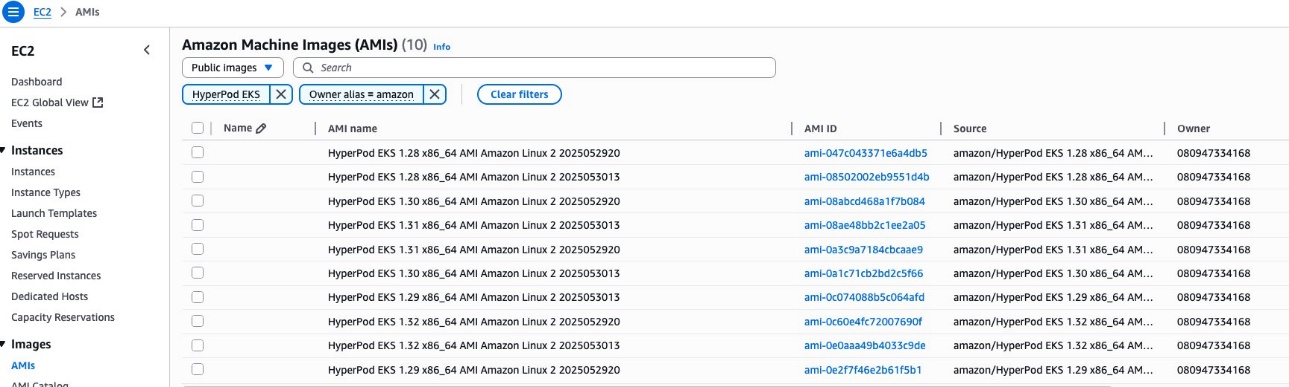
Alternatively, you should utilize the Amazon Command Line Interface (AWS CLI) with AWS Systems Manager to fetch the most recent SageMaker HyperPod base AMI:
Construct your customized AMI
After you choose a SageMaker HyperPod public AMI, use that as the bottom AMI to build your own custom AMI utilizing one of many following strategies. This isn’t an exhaustive listing for constructing AMIs; you should utilize your most popular methodology. SageMaker HyperPod doesn’t have any robust suggestions.
- Amazon EC2 console – Select your custom-made EC2 occasion, then select Motion, Picture and Templates, Create Picture.
- AWS CLI – Use the
aws ec2create-image command. - HashiCorp Packer – Packer is an open supply device from HashiCorp that you should utilize to create equivalent machine photos for a number of platforms from a single supply configuration. It helps creating AMIs for AWS, in addition to photos for different cloud suppliers and virtualization platforms.
- EC2 Picture Builder – EC2 Image Builder is a completely managed AWS service that makes it easy to automate the creation, upkeep, validation, sharing, and deployment of Linux or Home windows Server photos.
Arrange the required permissions
Earlier than you begin utilizing customized AMIs, verify you’ve got the required AWS Identity and Access Management (IAM) insurance policies configured. Ensure you add the next insurance policies to your ClusterAdmin consumer permissions (IAM coverage):
Run cluster administration operations
To create a cluster with a customized AMI, use the aws sagemaker create-cluster command. Specify your customized AMI within the ImageId parameter, and embrace different required cluster configurations:
Scale up an occasion group with the next code:
Add an occasion group with the next code:
Concerns
When utilizing customized AMIs together with your cluster, concentrate on the next necessities and limitations:
- Snapshot assist – Customized AMIs should comprise solely the foundation snapshot. Further snapshots are usually not supported and can trigger cluster creation or replace operations to fail with a validation exception if the AMI incorporates further snapshots past the foundation quantity.
- Patching –
ImageIdinupdate-clusteris immutable. For patching present occasion teams, you could use UpdateClusterSoftware withImageId. - AMI variations and deprecation – The public AMI releases page talks in regards to the public AMI variations and deprecation standing. Clients are anticipated to observe this web page for AMI vulnerabilities and deprecation standing and patch cluster with up to date customized AMI.
Clear up
To scrub up your sources to keep away from incurring extra costs, full the next steps:
- Delete your SageMaker HyperPod cluster.
- When you created the networking stack from the SageMaker HyperPod workshop, delete the stack as effectively to scrub up the digital personal cloud (VPC) sources and the FSx for Lustre quantity.
Conclusion
On this put up, we launched three options in SageMaker HyperPod that improve scalability and customizability for ML infrastructure. Steady provisioning affords versatile useful resource provisioning that will help you begin coaching and deploying your fashions quicker and handle your cluster extra effectively. With customized AMIs, you’ll be able to align your ML environments with organizational safety requirements and software program necessities. To be taught extra about these options, see:
In regards to the authors
 Mark Vinciguerra is an Affiliate Specialist Options Architect at Amazon Internet Providers (AWS) primarily based in New York. He focuses on Generative AI coaching and inference, with the aim of serving to prospects architect, optimize, and scale their workloads throughout varied AWS providers. Previous to AWS, he went to Boston College and graduated with a level in Pc Engineering. You’ll be able to join with him on LinkedIn.
 Anoop Saha is a Sr GTM Specialist at Amazon Internet Providers (AWS) specializing in generative AI mannequin coaching and inference. He companions with high frontier mannequin builders, strategic prospects, and AWS service groups to allow distributed coaching and inference at scale on AWS and lead joint GTM motions. Earlier than AWS, Anoop held a number of management roles at startups and huge firms, primarily specializing in silicon and system structure of AI infrastructure.
 Monidipa Chakraborty presently serves as a Senior Software program Improvement Engineer at Amazon Internet Providers (AWS), particularly throughout the SageMaker HyperPod crew. She is dedicated to aiding prospects by designing and implementing strong and scalable methods that show operational excellence. Bringing almost a decade of software program growth expertise, Monidipa has contributed to numerous sectors inside Amazon, together with Video, Retail, Amazon Go, and AWS SageMaker.
 Arun Nagpal is a Sr Technical Account Supervisor & Enterprise Help Lead at Amazon Internet Providers (AWS), specializing in driving generative AI and supporting startups via enterprise-wide cloud transformations. He focuses on adopting AI providers inside AWS and aligning know-how methods with enterprise goals to attain impactful outcomes.
 Daiming Yang is a technical chief at AWS, engaged on machine studying infrastructure that permits large-scale coaching and inference workloads. He has contributed to a number of AWS providers and is proficient in varied AWS applied sciences, with experience in distributed methods, Kubernetes, and cloud-native structure. Captivated with constructing dependable, customer-focused options, he makes a speciality of reworking complicated technical challenges into easy, strong methods that scale globally.
 Kunal Jha is a Principal Product Supervisor at AWS, the place he focuses on constructing Amazon SageMaker HyperPod to allow scalable distributed coaching and fine-tuning of basis fashions. In his spare time, Kunal enjoys snowboarding and exploring the Pacific Northwest. You’ll be able to join with him on LinkedIn.
 Sai Kiran Akula is an engineering chief at AWS, engaged on the HyperPod crew targeted on enhancing infrastructure for machine studying coaching/inference jobs. He has contributed to core AWS providers like EC2, ECS, Fargate, and SageMaker companion AI apps. With a background in distributed methods, he focuses on constructing dependable and scalable options throughout groups.