Construct dynamic net analysis brokers with the Strands Brokers SDK and Tavily

“Tavily is now obtainable on AWS Marketplace and integrates natively with Amazon Bedrock AgentCore Gateway. This makes it even sooner for builders and enterprises to embed real-time net intelligence into safe, AWS-powered brokers.”
As enterprises speed up their AI adoption, the demand for agent frameworks that may autonomously collect, course of, and synthesize info has elevated. Conventional approaches to constructing AI brokers usually require in depth orchestration code, express state administration, and inflexible architectures which can be troublesome to keep up and scale.
Strands Agents simplifies agent improvement by addressing these challenges. It introduces a model-centric paradigm that shifts the complexity from hard-coded logic into the big language mannequin (LLM) itself. This dramatically reduces improvement overhead whereas rising agent flexibility—for instance, minimizing the necessity to write express logic for every enter or output sort. By embedding logic immediately into the mannequin, brokers may be considerably improved just by swapping in additional superior fashions as they’re launched.
On this publish, we introduce tips on how to mix Strands Brokers with Tavily’s purpose-built net intelligence API, to create highly effective analysis brokers that excel at advanced info gathering duties whereas sustaining the safety and compliance requirements required for enterprise deployment.
Strands Brokers SDK: Mannequin-centric agent framework
The Strands Brokers SDK is an open supply framework that revolutionizes AI agent improvement by embracing a model-driven strategy. It affords a code-first, light-weight but highly effective framework for constructing agentic workflows. As a substitute of requiring advanced orchestration code, the Strands Brokers SDK helps builders create subtle brokers via three main elements:
- Fashions – Affords versatile integration with main LLM suppliers, together with Amazon Bedrock, Anthropic, Ollama, and LiteLLM, and offers an extensible interface for implementing customized mannequin suppliers.
- Instruments – Permits brokers to work together with exterior techniques, entry knowledge, and manipulate their atmosphere. Strands Brokers affords greater than 20 built-in instrument capabilities, and helps builders create customized instruments utilizing easy Python perform decorators.
- Prompts – Helps pure language directions that information agent habits and aims.
Strands Brokers affords a sophisticated and wealthy characteristic set. With the Strands Brokers SDK, builders can construct clever brokers with minimal code whereas sustaining enterprise-grade capabilities:
- Safety and accountable AI – Supplies seamless integration with guardrails for content material filtering, personally identifiable info (PII) safety, and extra
- Streamlined agent improvement lifecycle – Helps builders run brokers domestically and construct advanced analysis workflows that may be automated as a part of your steady integration and supply (CI/CD) pipelines
- Versatile deployment – Affords help for a lot of deployment choices, from devoted servers to serverless
- Observability – Helps OpenTelemetry normal for transmitting logs, metrics, and traces
Strands Brokers abstracts away the complexity of constructing, orchestrating, and deploying clever brokers, offering a pure language-based interplay and management coupled with dynamic output technology. The result’s a extra intuitive and highly effective improvement expertise.
Tavily: Safe, modular net intelligence for AI brokers
Tavily is an API-first net intelligence layer designed particularly for LLM brokers, powering real-time search, high-fidelity content material extraction, and structured net crawling. Constructed for builders constructing AI-based techniques, Tavily is engineered for precision, velocity, and modularity. It affords a seamless integration expertise for agent frameworks like Strands Brokers.Tavily’s API is an enterprise-grade infrastructure layer trusted by main AI firms. It combines strong capabilities with production-grade operational ensures, equivalent to:
- SOC 2 Type II compliance – Helps best-in-class safety and privateness posture
- Zero data retention – No queries, payloads, or person knowledge are saved, sustaining compliance with strict inner insurance policies and regulatory frameworks
- Plug-and-play with Amazon Bedrock and private LLMs – Helps hybrid cloud deployments, non-public language mannequin use, and latency-sensitive inference stacks
- Modular endpoints – Designed for agent-style interplay, Tavily offers purpose-built APIs for:
- Search – Retrieve semantically ranked hyperlinks and content material snippets throughout the general public net, filtered by area, recency, or depend
- Extract – Pull uncooked content material or cleaned markdown from identified URLs for summarization, QA, or embedding
- Crawl – Traverse web sites recursively via hyperlinks to simulate exploratory habits and construct web site maps
Every endpoint is uncovered as a standalone instrument, that means they are often rapidly wrapped into your agent framework’s instrument schema (equivalent to OpenAI’s tool-calling, LangChain, Strands, or ReAct-based implementations).
Combining Strands Brokers with the Tavily net infrastructure
By combining the flexibleness of the Strands Brokers SDK with Tavily’s real-time net intelligence capabilities, builders can construct dynamic, LLM-powered brokers that work together intelligently with the web. These brokers can motive over open-ended queries, make selections primarily based on pure language prompts, and autonomously collect, course of, and ship insights from the net.This integration may be acceptable for a variety of agent-based functions. For instance:
- Buyer success brokers that proactively retrieve the most recent product documentation, coverage updates, or exterior FAQs to resolve help points sooner
- Inner worker assistants that reply office questions by pulling from each inner instruments and publicly obtainable info, decreasing dependency on information silos
- Gross sales and income brokers that floor well timed firm information and trade shifts to help account planning and outreach
Every use case advantages from the identical basis: a developer-friendly agent framework, composable net intelligence instruments, and the decision-making energy of LLMs.To show how this comes collectively in follow, we discover a targeted implementation: a analysis agent designed for autonomous, high-fidelity net investigation.
Analysis agent instance
Many analysis agent implementations require in depth improvement efforts and depend on deterministic logic or workflows with constrained inputs and outputs. Alternatively, Strands allows builders to construct extremely dynamic brokers via pure language. Strands brokers use immediate engineering to dynamically generate different output varieties and settle for numerous pure language inputs seamlessly.Combining Tavily with Strands unlocks a brand new class of brokers purpose-built for deep, dynamic analysis. Not like hardcoded analysis pipelines, this pairing helps builders accomplish the next:
- Quickly develop highly effective analysis brokers utilizing Tavily’s endpoints (Search, Crawl, Extract) as instruments throughout the Strands Brokers framework, providing a developer-friendly interface
- Offload advanced decision-making counting on the LLM’s native capabilities
- Inherit efficiency boosts routinely with each new technology of mannequin (for instance, Anthropic Claude’s on Amazon Bedrock or Amazon Nova), because the versatile agent structure dynamically improves with minimal code modifications
- Mix the enterprise safety infrastructure of Amazon Bedrock with Tavily’s zero knowledge retention insurance policies to create a extremely safe atmosphere for delicate analysis duties
With Strands Brokers and Tavily’s capabilities mixed, the brokers excel in gathering trade intelligence and offering organizations with real-time insights into traits, competitor actions, and rising alternatives. Brokers can conduct complete aggressive evaluation, scouring huge quantities of on-line knowledge to determine strengths, weaknesses, and strategic positioning of trade gamers. Within the realm of technical analysis, these brokers can quickly assimilate and synthesize advanced info from a number of sources, which may help speed up innovation and problem-solving processes. Moreover, such brokers show invaluable for regulatory compliance monitoring by constantly scanning and decoding evolving authorized landscapes to ensure organizations keep forward of regulatory modifications. The flexibleness of the Strands Brokers SDK permits for personalization to particular trade wants—it’s equally efficient for duties starting from customer support automation to classy knowledge evaluation workflows.
Resolution overview
As an instance this mix, we created a deep researcher implementation (see the GitHub repo) that makes use of the agent loop functionality on the core of the Strands Brokers SDK to intelligently and autonomously select from Tavily’s net intelligence capabilities. The next diagram illustrates this workflow.
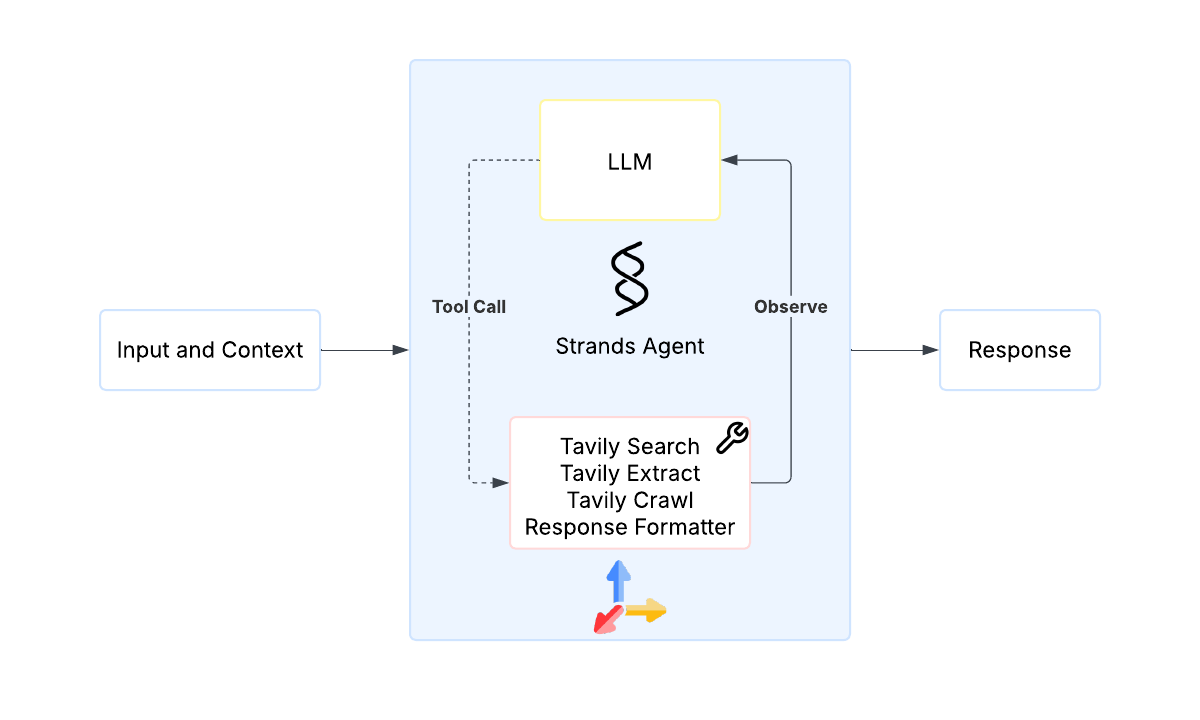
We configured the Strands Brokers SDK to make use of Anthropic’s Claude 4 Sonnet on Amazon Bedrock. Amazon Bedrock is a totally managed service that gives a alternative of high-performing basis fashions (FMs) from main AI firms via a unified API. The next diagram illustrates the answer structure.
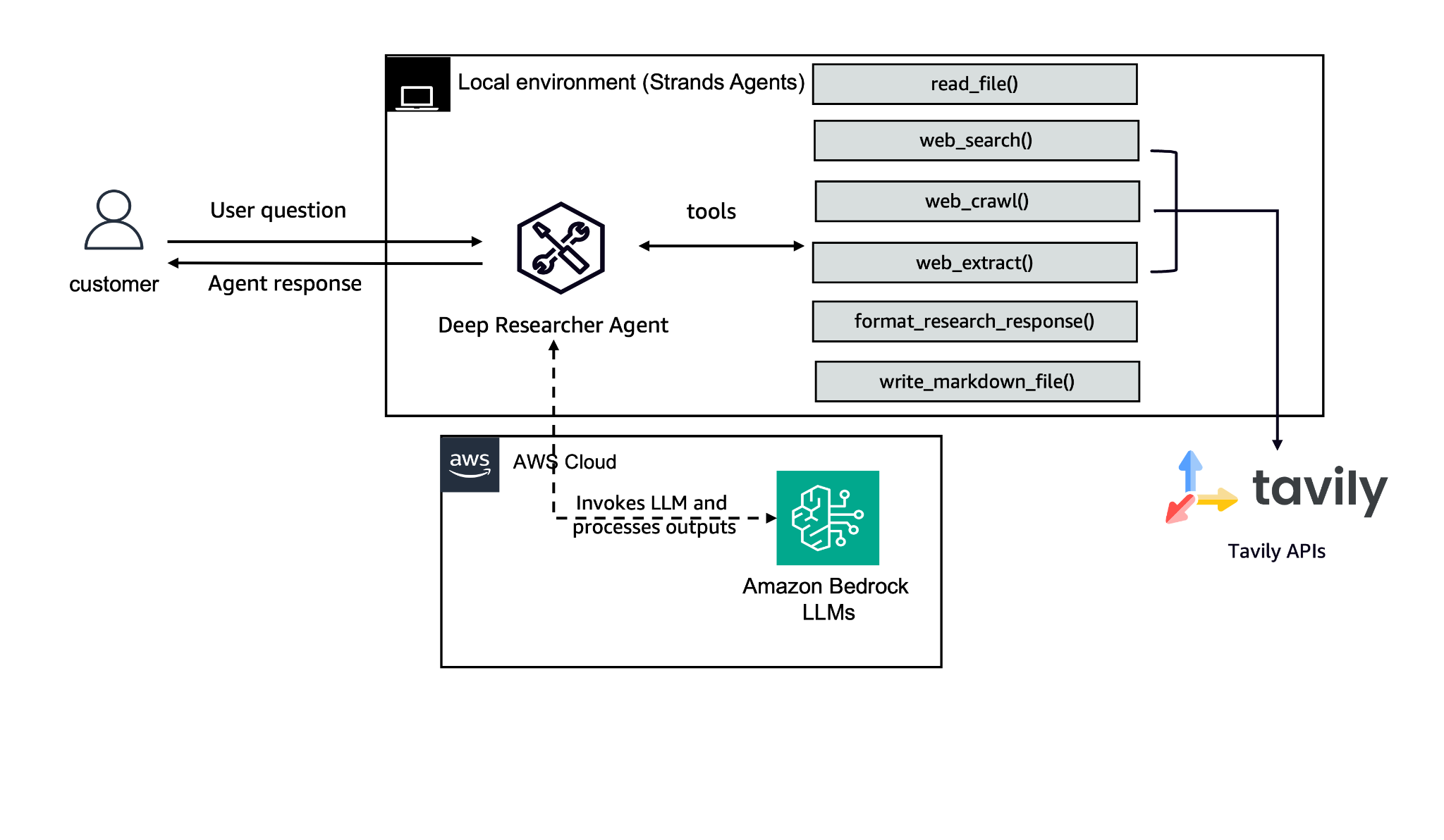
This analysis agent consists of three main elements:
- Giant language mannequin – Powers the agent to grasp queries and generate responses
- Instruments – Helps the agent collect info from the web utilizing Tavily’s APIs, format the response, and save the output in Markdown format
- System immediate – Guides the agent’s habits, outlining how and when to make use of every instrument to realize its analysis aims
Within the following sections, we talk about the LLM and instruments in additional element.
Giant language mannequin
The LLM influences the habits of the agent in addition to the standard of the generated response. We determined to make use of Anthropic’s Claude 4 Sonnet on Amazon Bedrock for its means to plan and execute advanced duties, however you need to use one of many different models supported by Amazon Bedrock or one other mannequin supplier.
Instruments
Instruments assist prolong brokers’ capabilities and work together with exterior providers equivalent to Tavily. We applied the next instruments to allow our agent to carry out deep analysis over the web and supply a formatted output:
- web_search – Search the net for related info
- web_extract – Extract the total web page content material from a webpage
- web_crawl – Crawl total web sites and scrape their content material
- format_research_response – Rework uncooked analysis content material into clear, well-structured, and correctly cited responses
- write_markdown_file – Save the analysis output in Markdown ahead on the native file system
To outline a instrument with the Strands Brokers SDK, you possibly can merely wrap a Python perform with the @instrument decorator and supply a Python docstring with the instrument description. Let’s discover an instance of how we applied the web_search instrument utilizing Tavily’s search endpoint.The search endpoint lets brokers uncover related webpages primarily based on a pure language question. Outcomes embrace URLs, title, content material snippets, semantic scores, and even the total content material of matched pages. You’ll be able to fine-tune searches with parameters equivalent to:
- Max variety of outcomes – Limits the variety of outcomes to an higher certain
- Time vary filtering – Limits the outcomes to content material printed inside a selected timeframe
- Area restrictions – Restricts outcomes to particular domains
See the next code:
LLMs rely closely on the instrument definition and outline to find out how and when to make use of them. To enhance instrument accuracy, take into account the next finest practices:
- Clearly clarify when the instrument needs to be used and its functionally
- Use sort hints within the perform signature to explain the parameters, return varieties, and default values
- Element every parameter and supply examples of the accepted codecs
Every Tavily endpoint may be uncovered to a language mannequin as a definite instrument, giving AI brokers versatile, granular entry to the net. By combining these instruments, brokers develop into dramatically extra succesful at duties like analysis, summarization, aggressive intelligence, and decision-making. Yow will discover the opposite instruments implementation within the GitHub repository.
Strategic worth proposition
AWS selected Tavily for the next advantages:
- Shared imaginative and prescient – Tavily and AWS each serve the subsequent technology of AI-based builders, with a powerful emphasis on enterprise-readiness, safety, and privateness
- Market integration – Tavily is out there on AWS Marketplace, making integration and procurement seamless for enterprise clients
- Go-to associate for net entry – AWS selected Tavily because the premier instrument for real-time search integration throughout the Strands Brokers SDK, offering the most effective net entry expertise for agent builders
- Amazon Bedrock – Amazon Bedrock is a totally managed, safe service that gives a alternative of high-performing FMs from main AI firms like Meta, Anthropic, AI21, and Amazon
Conclusion
The mixture of the Strands Brokers SDK and Tavily represents a major development in enterprise-grade analysis agent improvement. This integration may help organizations construct subtle, safe, and scalable AI brokers whereas sustaining the best requirements of safety and efficiency. To study extra, confer with the next sources:
Concerning the authors
 Akarsha Sehwag is a Generative AI Knowledge Scientist in Amazon Bedrock Brokers GTM group. With over six years of experience in AI/ML product improvement, she has constructed Machine studying options throughout numerous buyer segments.
 Lorenzo Micheli is a Principal Supply Advisor at AWS Skilled Companies, targeted on serving to World Monetary Companies and Healthcare organizations navigate their cloud journey. He develops strategic roadmaps for generative AI adoption and cloud-native architectures that drive innovation whereas making certain alignment with their enterprise aims and regulatory necessities.
 Dean Sacoransky is a Ahead Deployed Engineer at Tavily, specializing in utilized AI. He helps enterprises and companions use Tavily’s net infrastructure know-how to energy and improve their AI techniques.
 Lee Tzanani is Head of GTM and Partnerships at Tavily. She leads strategic collaborations with Tavily’s most beneficial companions and works with enterprise and Fortune 500 clients to combine real-time net search into manufacturing AI techniques. Lee drives Tavily’s go-to-market efforts throughout the AI panorama, advancing its mission to onboard the subsequent billion AI brokers to the net.
 Sofia Guzowski leads Partnerships and Group at Tavily, the place she works with firms to combine real-time net knowledge into their AI merchandise. She focuses on strategic collaborations, developer engagement, and bringing Tavily’s APIs to the broader AI panorama.