A Mild Introduction to Graph Neural Networks in Python

A Mild Introduction to Graph Neural Networks in Python
Introduction
Graph neural networks (GNNs) could be pictured as a particular class of neural community fashions the place knowledge are structured as graphs — each coaching knowledge used to coach the mannequin and real-world knowledge used for inference — fairly than fixed-size vectors or grids like picture, sequences, or cases of tabular knowledge.
Whereas standard neural community architectures like feed-forward fashions excel in modeling predictive issues like classification on structured, tabular knowledge or pictures, GNNs are designed to accommodate issues the place the relationships between knowledge entities are advanced and irregular. Take as an illustration social networks, molecular buildings, and data graphs. Like in any graph, the enter knowledge used for coaching and inference in GNNs is represented as a graph, with nodes representing entities (e.g. customers in a social community) and edges representing relationships (e.g. friendships or follows between customers).
Fascinated about higher understanding how GNNs work by means of a delicate sensible instance in Python? Then preserve studying.
Defining a Graph Neural Community in Python
On this introductory instance of constructing a GNN, we are going to think about a small graph dataset related to a social media platform, the place every node represents an individual and every edge connecting any two nodes is a friendship between individuals. Moreover, every node (individual) has related options just like the individual’s age, their pursuits, and so forth.
The goal job of the GNN we are going to construct is classifying individuals on both standard or not standard within the social community (binary classification), relying on whether or not having greater than two or lower than two buddies in it, and making an allowance for:
- The individual’s options, resembling their pursuits
- The individual’s connections with different individuals
Due to this fact, GNNs give an additional layer of sophistication to predictive duties, as a result of they not solely have a look at the goal occasion’s options to make a prediction but additionally at its relationship with different knowledge cases, not like classical classification and regression fashions.
With out additional ado, let’s begin coding. We’ll use a number of PyTorch parts appropriate for constructing GNNs, so we begin by putting in them first:
|
pip set up torch pip set up ogb pip set up torch_geometric pip set up networkx |
Now the required imports:
|
import os import torch import torch.nn.practical as F from torch_geometric.knowledge import Knowledge from torch_geometric.nn import GCNConv |
That is our “mini-social community” dataset or graph:
|
# Outline graph dataset edge_index = torch.tensor([ [0, 1, 0, 2, 0, 4, 2, 4], [1, 0, 2, 0, 4, 0, 4, 2], ], dtype=torch.lengthy) |
Mainly, edge_index is a matrix of edges or connections between customers. There are 5 customers, numbered 0 to 4. The primary connection is from person 0 to person 1, and we all know this by wanting on the first factor in every row of the matrix. The second connection is the reciprocal of the earlier one: person 1 to person 0. Then comes person 0 to person 2, and so forth. Consumer 3 appears to not be related to anybody but!
Now we mannequin two numerical options for every individual, in a tensor node_features: the individual’s age, and their curiosity in sports activities, with 1 indicating curiosity and 0 indicating no curiosity.
|
# Outline knowledge options node_features = torch.tensor([ [25, 1], # Individual 0 (25 years previous, likes sports activities) [30, 0], # Individual 1 (30 years previous, doesn’t like sports activities) [22, 1], # Individual 2 (22 years previous, likes sports activities) [35, 0], # Individual 3 (35 years previous, doesn’t like sports activities) [27, 1], # Individual 4 (27 years previous, likes sports activities) ], dtype=torch.float) |
Visualizing a Graph Neural Community in Python
One method to visualize our graph neural community in Python could be achieved through the use of the NetworkX library. It is going to create a graph from the sting listing and Matplotlib to show it. An instance of that is beneath.
|
1 2 3 4 5 6 7 8 9 10 11 12 13 14 15 16 17 18 19 20 21 22 |
import networkx as nx import matplotlib.pyplot as plt
# Convert the edge_index tensor to a listing of edge tuples edge_list = edge_index.t().tolist()
# Create a NetworkX graph from the sting listing G = nx.Graph() G.add_edges_from(edge_list)
# Optionally, embrace nodes that could be remoted (e.g., individual 3) G.add_nodes_from(vary(node_features.measurement(0)))
# Generate a structure for the nodes pos = nx.spring_layout(G, seed=42) # fastened seed for reproducibility
# Draw the graph with labels plt.determine(figsize=(6, 6)) nx.draw_networkx(G, pos, with_labels=True, node_color=‘lightblue’, edge_color=‘grey’, node_size=800) plt.title(“Visualization of the Social Community Graph”) plt.axis(‘off’) plt.present() |
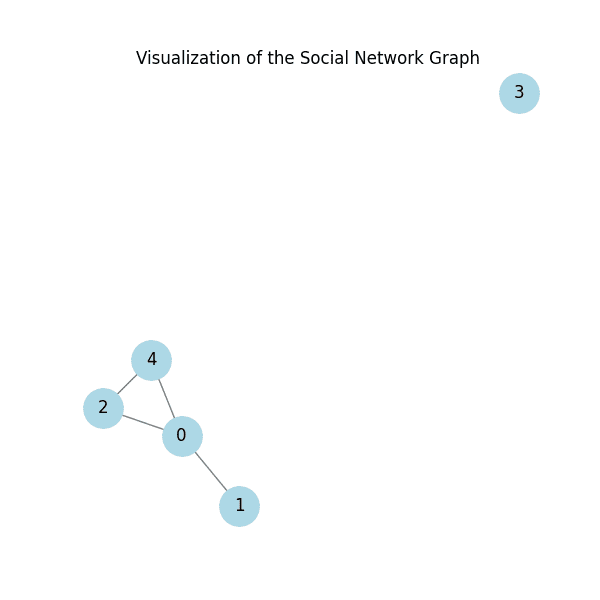
Determine 1: Visualization of the social community graph
Constructing a Graph Neural Community Mannequin in Python
Now we outline labels for the dataset of customers, i.e. whether or not an individual is standard or not, based mostly on whether or not the individual has greater than 2 buddies or not. The method entails calculating the variety of buddies of every individual (floor fact) based mostly on the adjacency matrix.
|
# Outline dataset labels num_friends = torch.tensor([3, 1, 2, 0, 3]) labels = (num_friends >= 2).lengthy() |
Utilizing the next masks, we are going to point out that the primary three individuals will likely be used as coaching knowledge to construct the GNN, and the opposite two will likely be used later for inference. Lastly, we additionally wrap the whole lot right into a Knowledge object.
|
# Masks for separating coaching and testing knowledge train_mask = torch.tensor([1, 1, 1, 0, 0], dtype=torch.bool) knowledge = Knowledge(x=node_features, edge_index=edge_index, y=labels, train_mask=train_mask) |
The following piece of code is essential. It defines the GNN structure and instantiates the mannequin. In PyTorch, GNN fashions could be constructed through the use of graph convolutional layers, resembling those carried out by the GCNConv class in torch_geometric.nn. Graph convolutional layers mixture data from a node’s neighbors, serving to study representations that seize not solely node options but additionally structural relationships within the graph.
|
# Outline mannequin class GNN(torch.nn.Module): def __init__(self, input_dim, hidden_dim, output_dim): tremendous(GNN, self).__init__() self.conv1 = GCNConv(input_dim, hidden_dim) self.conv2 = GCNConv(hidden_dim, output_dim)
def ahead(self, knowledge): x, edge_index = knowledge.x, knowledge.edge_index x = self.conv1(x, edge_index) x = F.relu(x) # Activation perform x = self.conv2(x, edge_index) return x
# Instantiate mannequin mannequin = GNN(input_dim=2, hidden_dim=4, output_dim=2) |
Coaching a Graph Neural Community in Python
The coaching mannequin is fairly just like coaching different forms of neural community fashions in PyTorch:
|
# Outline optimizer optimizer = torch.optim.Adam(mannequin.parameters(), lr=0.01)
# Prepare mannequin for epoch in vary(100): mannequin.prepare() optimizer.zero_grad()
out = mannequin(knowledge) loss = F.cross_entropy(out[data.train_mask], knowledge.y[data.train_mask])
loss.backward() optimizer.step()
if epoch % 10 == 0: print(f“Epoch {epoch}, Loss: {loss.merchandise():.4f}”) |
Pattern coaching output:
|
Epoch 0, Loss: 1.0987 Epoch 10, Loss: 0.8563 Epoch 20, Loss: 0.6542 Epoch 30, Loss: 0.5234 Epoch 40, Loss: 0.4231 Epoch 50, Loss: 0.3654 Epoch 60, Loss: 0.3120 Epoch 70, Loss: 0.2871 Epoch 80, Loss: 0.2654 Epoch 90, Loss: 0.2543 |
Graph Neural Community Inference in Python
As soon as the GNN has been educated, the inference course of is easy. We move the complete dataset to calculate recognition predictions, together with the 2 customers that weren’t seen throughout coaching, and print the outcomes. Discover that the argmax perform is used to acquire the category with the best chance for every person, from among the many two out there lessons: that is the essence of binary classifiers like logistic regressors.
|
# Check mannequin mannequin.eval() with torch.no_grad(): predictions = mannequin(knowledge).argmax(dim=1)
print(“nFinal Predictions (1=Standard, 0=Not Standard):”, predictions.tolist()) |
That is the ensuing listing of predictions:
|
# Check knowledge inference output Remaining Predictions (1=Standard, 0=Not Standard): [1, 1, 1, 0, 1] |
So, we will see that every one customers are deemed standard besides person 3, a.ok.a. the “lonely person.”
Wrapping Up
To sum up, we now have constructed a quite simple GNN that makes use of a graph illustration of a dataset to carry out predictions based mostly not solely on the options of cases (represented by nodes) but additionally by wanting on the relationships or connections with different cases.